
If you’re recovering from alcohol dependence and looking to stay alcohol-free, acamprosate might help you maintain that progress. It’s an FDA-approved medication designed specifically to support your journey after you’ve completed detox.
Acamprosate works by helping to restore balance, so your brain can stabilise and you’re less likely to crave alcohol. But here’s the key part: acamprosate won’t help if you’re still going through withdrawal. It works best when you combine it with counselling or behavioural therapy, not on its own.
According to the 2019 National Survey of Substance Abuse Treatment Services (N-SSATS), 24.3% of substance use treatment facilities in Pennsylvania offered acamprosate (Campral®) as a treatment for alcohol use disorder (AUD).
What Is Acamprosate?
Acamprosate is a prescription medication approved by the U.S. Food and Drug Administration (FDA) for treating alcohol use disorder (AUD). Marketed under the brand name Campral, it is specifically used to help individuals maintain abstinence from alcohol after completing detoxification.
It does not treat alcohol withdrawal symptoms, nor does it reduce cravings in the acute phase of withdrawal. Campral works best when combined with psychosocial support, such as counseling or behavioral therapy.
According to the same 2019 N-SSATS report by SAMHSA, 98.6% of inpatient facilities that treated alcohol dependence in Pennsylvania prescribed or dispensed acamprosate as part of their rehabilitation services.
How Does Acamprosate Help in Alcohol Addiction Recovery?
Acamprosate helps you in alcohol addiction recovery by reducing cravings, restoring your brain’s chemical balance, and supporting long-term abstinence.
It works by boosting your GABA activity — the calming signals in your brain — and blocking glutamate at the NMDA receptor. This helps stabilise your central nervous system as you recover.
Acamprosate reduces glutamate hyperactivity by modulating N-methyl-D-aspartate (NMDA) receptors, and enhances GABA signaling, which calms the central nervous system.
Why Does Acamprosate Require a Full Detox Before Starting Treatment?
Acamprosate requires a full detox before starting treatment because it is only effective after alcohol has been completely cleared from the body. It does not manage acute withdrawal symptoms and has no benefit during the withdrawal phase. Instead, it supports long-term abstinence by normalizing disrupted brain chemistry following detox.
The drug is designed to stabilize neurotransmitter activity in the central nervous system after the withdrawal phase ends. Initiating acamprosate while alcohol is still present interferes with its mechanism and renders it ineffective.
According to the National Institute on Drug Abuse (NIDA), medications like acamprosate are most effective when started 5 to 7 days post-detox, when the brain begins to recalibrate after prolonged alcohol use.
How Long Does It Take for Acamprosate to Work?
It takes 5 to 8 days of consistent use for Acamprosate to work, but full therapeutic impact takes up to 30 days, depending on individual response and the severity of alcohol dependence. During this period, the medication works gradually to stabilize neurotransmitters, reduce cravings, and support abstinence.
Skipping doses or stopping treatment prematurely reduces effectiveness and increases relapse risk. Continuous daily use, even when no immediate changes are felt, is essential for long-term benefit.
What Are the Approved Uses of Acamprosate?
The approved uses of acamprosate are the maintenance of abstinence, prevention of relapse, and support in long-term recovery for individuals diagnosed with alcohol use disorder (AUD).
It is an FDA-approved medication specifically indicated for patients who have already completed detox and are committed to remaining alcohol-free.

Acamprosate does not treat alcohol withdrawal symptoms or reduce the desire to drink during active alcohol use. Its primary function is to stabilize the brain’s neurochemical balance during early recovery, thereby reducing the risk of relapse.
Who Should Avoid Taking Acamprosate?
People with severe renal impairment, pregnant or breastfeeding women, and individuals allergic to acamprosate calcium should avoid taking acamprosate. Patients with moderate renal impairment also require adjusted dosing and close monitoring due to reduced drug clearance.
What Is the Recommended Dosage of Acamprosate?
The standard recommended dose of acamprosate is 666 mg, taken three times daily as delayed-release tablets, totaling 1,998 mg per day. This dosage is prescribed for adults with normal kidney function who have completed detox and committed to maintaining abstinence from alcohol.
For people with moderate renal impairment (creatinine clearance between 30–50 mL/min), the dose should be reduced to 333 mg three times daily. Acamprosate is contraindicated in individuals with severe renal impairment (creatinine clearance ≤30 mL/min), as the drug is eliminated primarily through the kidneys.
How is Acamprosate Administered?
Acamprosate is administered by mouth as delayed-release tablets, usually 666 mg taken three times a day, with or without food. Tablets should be swallowed whole, not crushed or chewed, to preserve their extended-release formulation.
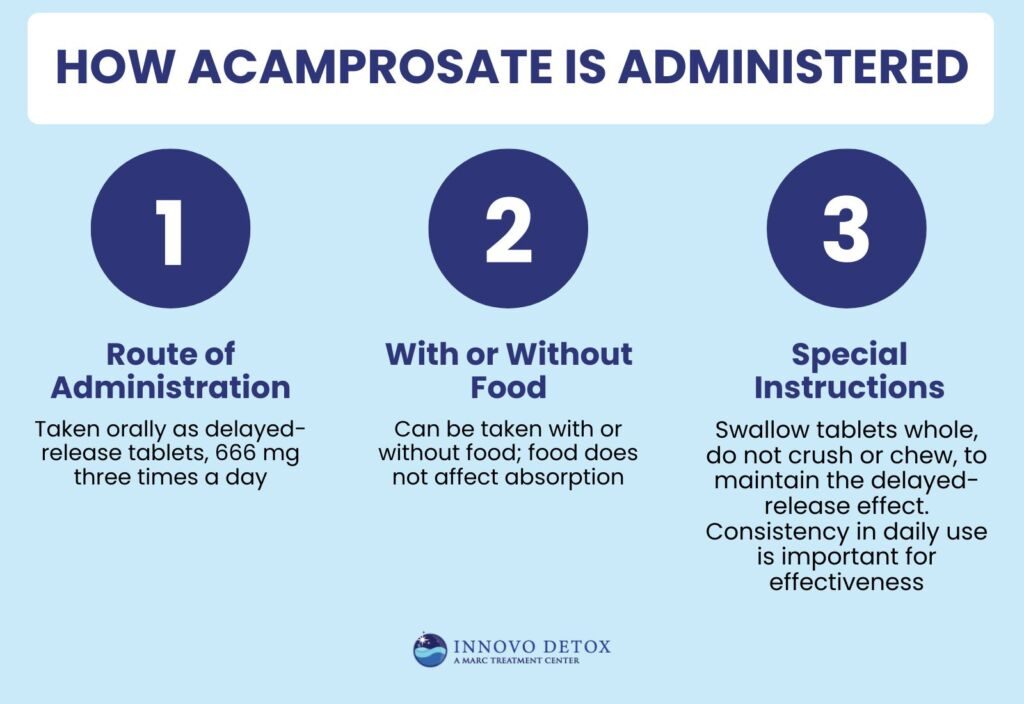
Ways acamprosate is administered are explained below:
- Route of administration: Acamprosate is taken orally as delayed-release tablets. The standard dose is 666 mg three times daily. It should be taken at the same time each day to maintain consistent drug levels.
- With or without food: It can be taken with or without food. Taking it with meals improves adherence for some patients. Food does not affect the absorption of the medication.
- Special instructions: Tablets must be swallowed whole, not crushed or chewed. Breaking the tablet disrupts the delayed-release mechanism. Consistent daily use is essential for full therapeutic benefit.
What Should You Do If You Miss a Dose of Acamprosate?
Take the missed dose of acamprosate as soon as you remember when you miss a dose of acamprosate. However, if it’s almost time for your next scheduled dose, skip the missed one—do not double up to make up for it, as this increases overdose risk.
How Long Should You Take Acamprosate?
You should take acamprosate for six months to a year or longer, depending on individual recovery needs and relapse risk. Most patients benefit from continued use for at least 12 months, especially those with severe alcohol use disorder (AUD) or repeated relapses.
What Are the Side Effects of Acamprosate?
The side effects of acamprosate are diarrhea, nausea, flatulence, insomnia, and itchy skin. According to FDA data, diarrhea is the most common, reported in 16% of patients, but most side effects are mild and decrease over time.

The side effects of acamprosate are explained below:
- Diarrhea: Loose or frequent stools are the most frequently reported mild side effect. It usually appears in the early weeks of therapy and resolves without intervention. \
- Nausea: Some individuals experience mild stomach upset or queasiness. Taking the medication with food reduces this effect.
- Flatulence: Bloating and increased intestinal gas are occasional, mild complaints. This effect is typically mild and transient.
- Insomnia: Difficulty sleeping occurs, particularly during the first few weeks of treatment. It is linked to the brain’s adjustment during abstinence..
- Itchy skin (pruritus): Mild itching occurs on the skin without rash. This mild effect is rare and usually does not require stopping the medication. Most cases resolve spontaneously.
- Allergic reactions: These include swelling, rash, or difficulty breathing. Though serious reactions are rare, immediate medical attention is required. The FDA prescribing information (Campral, 2004) lists hypersensitivity as a rare but documented serious adverse effect.
- Depression or suicidal thoughts: Mood-related symptoms emerge in a small subset of patients. Monitoring is recommended, especially in those with a history of depression.
- Irregular heartbeat: Cardiovascular side effects are uncommon and occur in those with preexisting heart conditions. There is limited evidence linking acamprosate directly to arrhythmias, but clinical judgment is advised.
Does Acamprosate Cause Dependence?
No, Acamprosate does not cause dependence because it does not affect dopamine or opioid receptors, which are responsible for producing euphoria and reinforcement. It is a non-addictive medication that works by stabilizing neurotransmitters in the central nervous system, not by triggering reward pathways.
What Are the Alternatives to Acamprosate for Alcohol Addiction Treatment?
The alternatives to acamprosate for alcohol addiction treatment are naltrexone, disulfiram, and off-label options like topiramate or gabapentin. These medications work through different mechanisms to help with alcohol addiction.

The alternatives to acamprosate for alcohol addiction treatment are explained below:
- Naltrexone: Naltrexone is an FDA-approved opioid receptor antagonist used to reduce alcohol cravings and block the pleasurable effects of drinking. It is effective during active drinking and does not require detox prior to use.
- Disulfiram: Disulfiram is a deterrent medication that inhibits acetaldehyde dehydrogenase, causing unpleasant reactions such as nausea, flushing, and chest pain if alcohol is consumed. It is best suited for patients with strong motivation and structured supervision.
- Topiramate (off-label): Topiramate is an anticonvulsant that modulates GABA and glutamate pathways, showing efficacy in reducing cravings and alcohol consumption. It is not FDA-approved for AUD, but it has shown strong comparative benefits.
- Gabapentin (off-label): Gabapentin is a GABA analog used to manage alcohol withdrawal symptoms, insomnia, and anxiety during early recovery. It is often prescribed off-label to support abstinence.
Can Acamprosate Be Used in Combination with Other Medications?
Yes, Acamprosate can be used in combination with other medications, including nalmefene, naltrexone, and certain antidepressants. However, it is necessary to consult a doctor about potential drug interactions.
Nalmefene, an opioid receptor antagonist similar to naltrexone, is used with acamprosate to reduce alcohol cravings and the risk of relapse, though it increases the risk of side effects like gastrointestinal distress or mood changes.
When combined with antidepressants, such as SSRIs (selective serotonin reuptake inhibitors), acamprosate has not shown significant interactions, but it is important to monitor for changes in mood or sleep disturbances.
Can Acamprosate and Naltrexone Be Taken Together?
Yes, Acamprosate and Naltrexone can be taken together, as they work through different mechanisms to improve outcomes for individuals with alcohol use disorder (AUD).
Acamprosate stabilizes neurochemical balance by modulating GABA and glutamate, while naltrexone blocks the opioid receptors involved in alcohol’s rewarding effects.
Can Acamprosate and Disulfiram Be Used Together?
Yes, Acamprosate and Disulfiram can be used together, but they work through different mechanisms. Disulfiram creates an aversion to alcohol by inhibiting acetaldehyde dehydrogenase, leading to uncomfortable symptoms such as nausea and flushing when alcohol is consumed.
This aversion therapy helps prevent alcohol consumption during early recovery. On the other hand, Acamprosate helps maintain abstinence by stabilizing neurochemical balance in the brain to reduce cravings and withdrawal symptoms.
What Happens if You Drink Alcohol While Taking Acamprosate?
Drinking alcohol while taking acamprosate does not cause a physical reaction, like with disulfiram, but it significantly reduces acamprosate’s effectiveness in helping maintain abstinence.
Acamprosate works by stabilizing the neurochemical balance in the brain, and consuming alcohol while on the alcohol addiction medication can disrupt this process, leading to an increased risk of relapse.
What Is the Success Rate of Acamprosate in Preventing Alcohol Relapse?
The success rate of acamprosate in preventing alcohol relapse is significant, with studies showing higher abstinence rates compared to placebo.
According to the Pennsylvania Department of Drug and Alcohol Programs (DDAP) 2020 Annual Report, 39.7% of individuals in the state who used acamprosate as part of their alcohol treatment programme reported achieving complete abstinence after one year of treatment.
The medication is especially effective when used in combination with psychosocial support, which further boosts long-term abstinence outcomes.
Does Insurance cover Acamprosate?
Yes, Acamprosate is covered by insurance. Coverage specifics, including copayments, vary by plan. Medicare Part D includes Acamprosate, though costs vary.
Acamprosate coverage is widespread but includes restrictions like prior authorizations or quantity limits. Private insurance plans cover it, but formulary placement and copayments differ among insurers.
It’s advisable to consult your specific insurance provider to understand coverage details and potential out-of-pocket costs.
Can You Buy Acamprosate over the Counter in Pennsylvania?
No, Acamprosate is not available over the counter in Pennsylvania because it is a prescription medication that requires a healthcare provider’s evaluation and supervision. As a treatment for alcohol use disorder (AUD), its use must be carefully monitored to ensure effectiveness and manage potential side effects.


